Hidden methane emerging from beneath the ice reveals Greenland's sensitivity to climate change
https://www.oulu.fi/en/news/hidden-methane-emerging-beneath-ice-reveals-greenlands-sensitivity-climate-changeA new study reveals how responsive the Greenland ice sheet is to climate change – more so than models predict. Methane has been detected at retreating glacier margins worldwide, but this is the first time that a study has investigated the margin of an entire ice sheet.
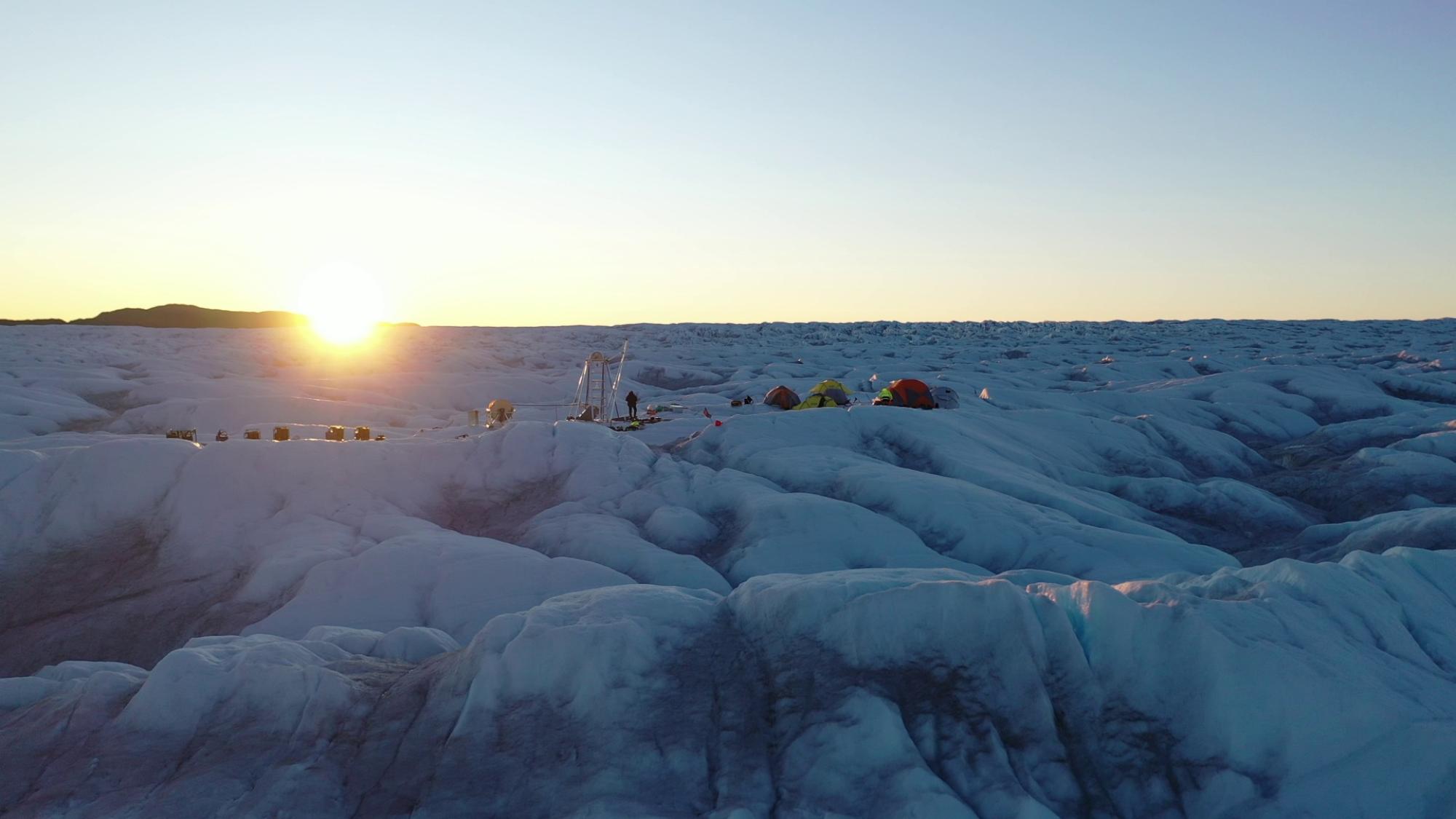
This international project drilled over 1200 m through to the bed of the Greenland ice sheet to collect basal sediment cores and samples of organic carbon along with the methane producing microbes that metabolize it. Photo: Alun Hubbard / Oulu University
In the new paper, an international collaboration including Charles University, Czechia, and University of Oulu, presents evidence linking widespread methane (CH4) release – a potent greenhouse gas – from beneath the Greenland Ice Sheet to an episode of warming around 4,000 years ago, known as the Holocene Thermal Maximum.
The scientists collected samples from a 2000 km-long transect of the western margin of the Greenland Ice Sheet and used stable isotope analysis and radiocarbon dating to constrain the origin and age of the methane exported by emerging subglacial meltwater. They found the methane was 1500-4500 years old, produced biologically by anaerobic microbes that metabolise decaying organic matter in sediments beneath the ice sheet, where oxygen is limited.
The implication is that the ice sheet retreated significantly inside its present margins after the last ice age, allowing boreal and tundra vegetation to grow in the newly exposed areas. This was subsequently overridden by the readvancing ice in the following colder period. The retreat suggests a highly dynamic ice sheet, one that is far more sensitive to climate change than previously thought with clear implications for its future behaviour.
“Our study reveals startling insights into just how responsive the Greenland ice sheet is to climate change. That it abruptly retreated to a configuration much smaller than present under levels of Arctic warming on a par with that ongoing today, is a bleak reminder of its future committed loss to global sea-level rise and coastal flooding, if we can’t get our act together to curb greenhouse gas emissions. The ultimate irony”, says co-author
Alun Hubbard from the University of Oulu, “is that as it retreats, the ice sheet itself further contributes to those methane emissions.”
…
Hatton, J.E., Stehrer-Polášková, A., Píka, P.A.
et al. Mid-Holocene retreat of the Greenland Ice Sheet indicated by subglacial methane release.
Nat. Geosci. (2026).
https://doi.org/10.1038/s41561-026-01976-5
